What Foods Are High in Quercetin — And How Much Do You Actually Get Compared to a Capsule?
Have you ever tried to eat your way to better health… and felt like it just wasn’t enough?
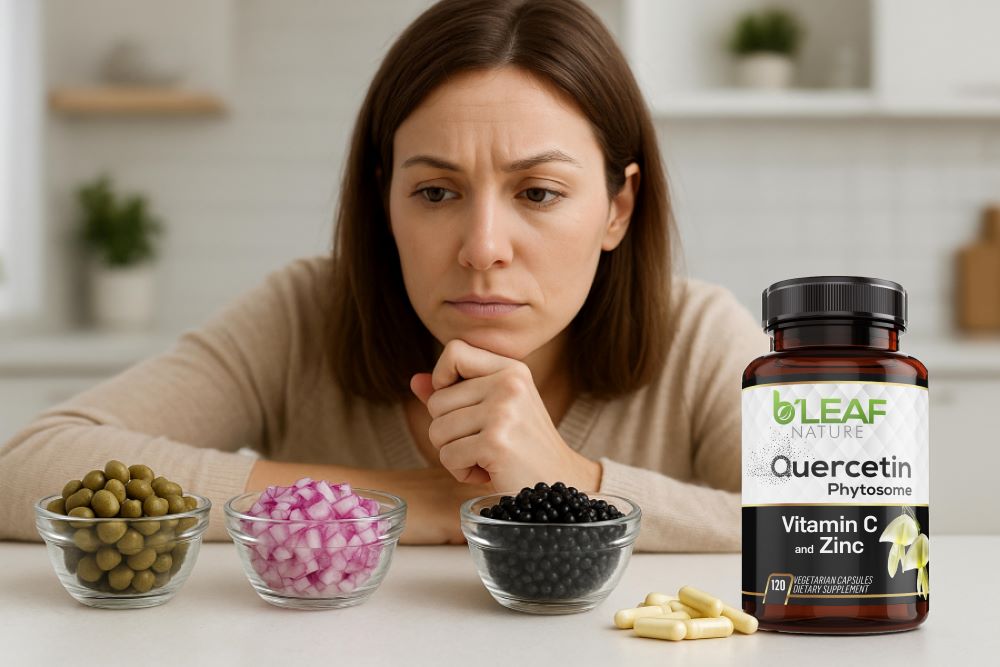
Maybe you’ve been loading up on red onions, sipping green tea, or tossing blueberries into every meal — hoping to boost your immune system, manage your allergies, or ease inflammation. Perhaps you’ve heard Quercetin is good for you, but despite your best efforts, the results are… subtle at best.
That’s where many people get stuck. You’re doing all the “right” things, but you’re still wondering:
-
Am I getting enough Quercetin from food?
-
Is there a more efficient way to get its benefits without overhauling my entire diet?
If that sounds like you, this breakdown will help you understand where Quercetin really comes from, how much is in common foods, and when it might be time to consider supplementation — especially in a form your body can actually absorb.
Foods Naturally High in Quercetin
Quercetin is a powerful flavonoid found in many plant-based foods. For instance, here are some of the richest natural sources, along with their approximate Quercetin content per 100g:
| Food | Approx. Quercetin (mg) |
|---|---|
| Capers (raw) | 234 mg |
| Red onions (raw) | 33–55 mg |
| Shallots | 35 mg |
| Apples (with skin) | 4–10 mg |
| Kale (raw) | 7 mg |
| Buckwheat (raw) | 23 mg |
| Elderberries | 42 mg |
| Broccoli (raw) | 3 mg |
| Blueberries | 3 mg |
| Green tea (1 cup brewed) | 2–5 mg |
Keep in mind: Quercetin levels vary depending on how fresh the food is, where it’s grown, and how it’s cooked.
Why Diet Alone Might Not Be Enough?
Let’s say you want to get 500 mg of Quercetin — a common dosage found in supplements used to support inflammation, immune response, or allergy relief. Here’s what you’d be looking at from food:
-
That’s 10+ red onions,
-
Or two full cups of raw capers,
-
Or a truckload of apples, berries, and tea… every single day.
In other words, if you’re eating clean and plant-rich, it’s tough to hit these levels consistently. And most people don’t — especially if they’re already managing a busy lifestyle, dietary restrictions, or health goals.
Not All Quercetin Is Created Equal: The Bioavailability Factor
Even if you’re eating the right foods or taking regular Quercetin supplements, there’s one more issue: absorption. Traditional Quercetin is notoriously hard for the body to absorb. Much of it just passes through the digestive system without being used.
That’s why many new delivery systems have been developed like Phytosome, Liposomal or Bromelain fillers.
Quercetin Phytosome, for example, uses a clinically studied form of Quercetin developed by Indena — a reputable Italian lab — that binds Quercetin to sunflower lecithin (a phospholipid). This formulation has been shown to improve absorption by up to 20x compared to standard Quercetin.
So instead of overwhelming your plate or swallowing multiple capsules daily, you can get more Quercetin where it counts — with less effort and greater impact.
The bottom line
If you’re relying on food alone to get the benefits of Quercetin, you may be falling short — and not even know it. Adding a supplement with Quercetin Phytosome gives your body a real chance to absorb and use this powerful flavonoid, especially when you’re aiming for targeted support like immune health, and allergy management.
Statements regarding dietary supplements have not been evaluated by the FDA and are not intended to diagnose, treat, cure, or prevent any disease or health condition.