
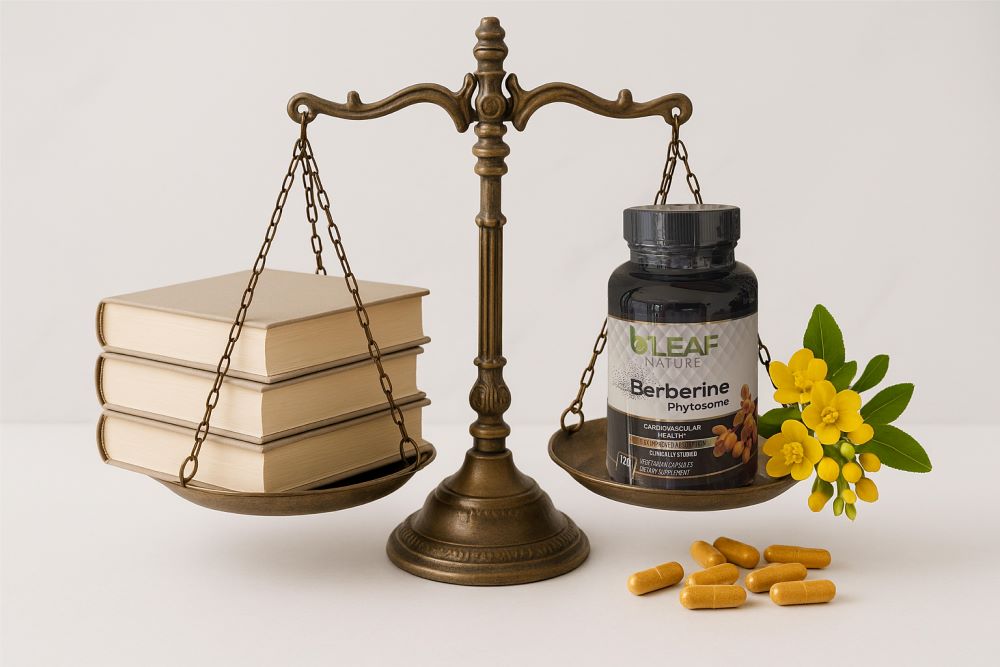
Berberine, a natural compound found in plants like Berberis aristata—has gained attention for its role in supporting metabolic health and weight management. But is it really effective for weight loss? And how does it work in the body?
In this article, we explore what the science says about Berberine, how it interacts with your metabolism, and what kind of results are realistic when it’s taken consistently as part of a healthy lifestyle.
Research suggests Berberine may help support healthy weight loss through several metabolic pathways:
1. A key role in insulin sensitivity
Berberine activates AMPK, a key enzyme that helps cells absorb glucose and use energy more efficiently. This makes the body more sensitive to insulin and may reduce the kind of blood sugar spikes that lead to fat storage.
2. Supports Fat Storage metabolism at the Cellular Level
Berberine supports fat metabolism by downregulating PPARγ, a gene involved in fat cell development. It may also enhance lipolysis, the breakdown of fat to be used as energy.
3. A Healthier Gut Microbiome
The gut microbiome plays a surprising role in weight regulation. Berberine can help restore microbial balance by supporting beneficial strains such as Akkermansia, which is linked to improved metabolism.
4. Effects to Blood Lipids
Berberine has been shown to reduce LDL (“bad”) cholesterol and triglycerides, which are often elevated in individuals with metabolic issues.
5. Stable Glucose = Less Food Cravings
Stable glucose often means fewer energy crashes and food cravings. By supporting the regulation of blood glucose, Berberine may indirectly support better appetite control.
Berberine is not a substitute for healthy habits. It works best as part of a holistic approach that includes:
A whole-foods diet
Consistent movement or exercise
Proper sleep and stress management
Our Berberine Phytosome Capsules make it easier to incorporate this powerful ingredient into your daily routine, with enhanced absorption that supports noticeable effects with fewer capsules.
Berberine supplements come in different forms, and not all are created equal when it comes to absorption and effectiveness. Berberine dihydrochloride is the most common and affordable form, but it has low bioavailability, meaning your body absorbs only a small fraction—often requiring higher doses that may cause digestive discomfort.
Some formulas combine Berberine with cinnamon, aiming to support blood sugar control by pairing two ingredients known for metabolic benefits. While this combination may be helpful for some, it doesn’t improve Berberine’s absorption or reduce the need for higher doses.
Berberine Phytosome, on the other hand, is a next-generation formulation where Berberine is bound to a natural phospholipid complex to enhance its absorption in the body—up to 10 times more than standard extracts. This allows for lower, more effective doses with improved tolerability. Our capsules use this clinically studied delivery system and are made with clean, plant-based ingredients sourced from reputable partners like Indena, known for their high-quality botanical research and manufacturing standards.
Some people may experience mild gastrointestinal symptoms like bloating or nausea—especially in the first week. This is often due to Berberine’s effect on gut flora or bile production.
To help ease this:
Take it with meals
Split the dosage across the day
Look for products that include digestive-supportive compounds such as grape seed extract, ginger, or peppermint
Choose enhanced absorption forms like Berberine Phytosome, which require lower doses and tend to be gentler on the stomach
We recommend starting with 1 capsule (500 mg) once or twice daily, depending on your needs. Our Chanca Piedra capsules are:
Made with pure extract only
Contain no fillers or artificial additives
Easy to swallow and gentle on digestion
Always listen to your body and adjust based on how you feel—or speak with a healthcare professional if you’re unsure.
Berberine is not a magic bullet, but it is a promising, well-studied natural supplement that may support weight loss by improving how your body processes glucose, stores fat, and manages cravings. It works best when paired with a healthy diet and lifestyle.
If you’re exploring natural ways to support your metabolism, Berberine—especially in more absorbable forms—could be a smart tool in your wellness routine.
Statements regarding dietary supplements have not been evaluated by the FDA and are not intended to diagnose, treat, cure, or prevent any disease or health condition.
Yin, J., Gao, Z., Liu, D., Liu, Z., & Ye, J. (2008). Berberine improves glucose metabolism through induction of glycolysis. American journal of physiology. Endocrinology and metabolism, 294(1), E148–E156. https://doi.org/10.1152/ajpendo.00211.2007
Xu, M., Xiao, Y., Yin, J., Hou, W., Yu, X., Shen, L., Liu, F., Wei, L., & Jia, W. (2014). Berberine promotes glucose consumption independently of AMP-activated protein kinase activation. PloS one, 9(7), e103702. https://doi.org/10.1371/journal.pone.0103702
Hu, Y., & Davies, G. E. (2010). Berberine inhibits adipogenesis in high-fat diet-induced obesity mice. Fitoterapia, 81(5), 358–366. https://doi.org/10.1016/j.fitote.2009.10.010
Zhang X, Zhao Y, Zhang M, Pang X, Xu J, et al. (2012) Structural Changes of Gut Microbiota during Berberine-Mediated Prevention of Obesity and Insulin Resistance in High-Fat Diet-Fed Rats. PLOS ONE 7(8): e42529. https://doi.org/10.1371/journal.pone.0042529
Kong, W., Wei, J., Abidi, P. et al. Berberine is a novel cholesterol-lowering drug working through a unique mechanism distinct from statins. Nat Med 10, 1344–1351 (2004). https://doi.org/10.1038/nm1135
Yin, J., Xing, H., & Ye, J. (2008). Efficacy of berberine in patients with type 2 diabetes mellitus. Metabolism: clinical and experimental, 57(5), 712–717. https://doi.org/10.1016/j.metabol.2008.01.013